
Atlas
Step into a world
and find a story there.
28 hand-painted worlds, each with its own cast and a shelf of stories that only happen there.
Worlds
Pick a world to explore

Driftpine Harbor
Driftpine Harbor bends around a wide scoop of gray water, where the shore is lined not with big piers but with sloping timber ramps, floating sheds, and a long row of pine pilings blackened by salt. The air smells of brine, sun-warmed tar, and resin from the driftwood stacks that dry beside the net racks. Small boats rest nose-in at the ramps, rocking gently against one another, while ropes whisper and taps of wood sound whenever the harbor sways.




Mooncup Grotto
Mooncup Grotto is a round underwater chamber tucked behind a curtain of swaying anemones, its walls pale as washed stone and dimpled with hundreds of little cup-shaped hollows. Soft light slips in from a crack overhead and spreads across the floor in quivering silver patches, touching strands of pink sea grass and the round backs of sleeping snails. The place smells faintly of salt and something sweet, like crushed shells after rain. A shallow sand slope leads down to a bowl of still water in the center, and smooth ridges along the walls make narrow paths for careful fins and tiny feet. Bubble trails often gather under the ceiling and break free in slow, tickling bursts. Hermit crabs, shy minnows, and drifting bits of kelp make the grotto feel occupied without ever feeling crowded. Each day the light changes shape, and each tide nudges a little sand from one side to another, so the room never looks exactly the same twice.



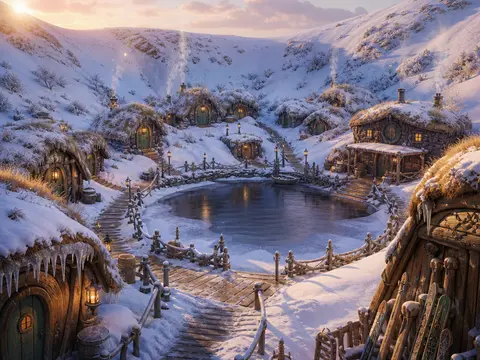
Mosscap Snow Hollow
Mosscap Snow Hollow rests in a round dip between pale hills, where the snow is deep and quiet and the cold smells faintly of stone, wool, and woodsmoke. Low cabins with grass-tuft roofs cluster around a black pond that only freezes at the edges, and narrow board paths curve between doorways, a bathhouse, and a shed full of carved skis. The wind comes differently here, slipping over the hilltops in soft sheets that rattle shutters and carry little spirals of powder across the lanes. People leave mittened prints on the packed paths, and sled dogs curl beside fences made from bent willow poles. In the mornings, chimney smoke hangs low before rising straight up, and in the evenings the pond gives a tiny cracking sigh. Icicles grow thick along eaves, then melt into drips that darken the steps. It is a place of warm windows, sloped roofs, careful crossings, and small changes in the snow that show who passed by and where the day has gone.




Puffcap Tramline
Puffcap Tramline is a narrow sky path of rattling tram cars that slides between pale cloud islets and crooked roof platforms. The cars are painted in faded mint and berry stripes, with brass rails warm from sun and cool in the shade. Below, the cloud banks open and close like slow, sleepy waves, while above, kites, gulls, and long streamers drift through the blue. The air smells of rainwater, metal dust, and sweet buns from the little snack carts that roll at the stations. The tramline bends past washing terraces, windbreak hedges in barrel pots, and tiny waiting rooms with fogged glass. Every stop has its own sound: a bell, a whistle, a clink of cups, a shuffle of boots, a soft flap of tarps. Ropes sway, door latches chatter, and sudden gusts can tilt hats or make the cars sing. Children, gardeners, porters, and sleepy travelers leave chalk arrows, dropped feathers, and half-tied ribbons behind, so the whole place feels busy, breezy, and always almost on the move.



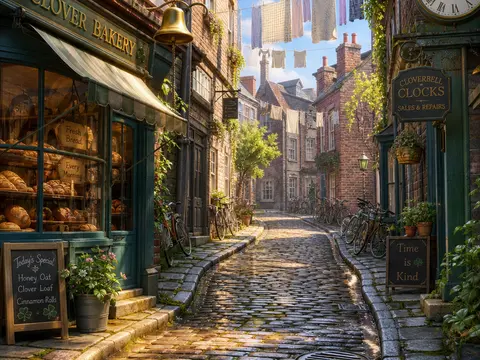
Cloverbell Alley
Cloverbell Alley is a narrow town street that bends between old bakery windows, a sleepy clock shop, and a row of brick houses with moss on their steps. Morning smells like warm bread, wet cobblestones, and laundry drifting from lines overhead. By afternoon, bicycles lean in tidy piles, cats nap in doorways, and chalk drawings fade where the sun reaches the pavement. The alley is busiest when the corner bell rings from the bakery and when delivery carts rattle through with jangling bottles and paper parcels. Rain gathers in little silver streams along the gutter, and everyone knows to hop the shallow puddles near the tilted drain cover. Behind the front doors are small, lively rooms, but outside is where neighbors pause, wave, and trade stories. Tiny surprises seem to appear in the ordinary flow of the street: a lost mitten on a railing, a ribbon caught in a hedge, a paper boat sailing through a runoff stream.



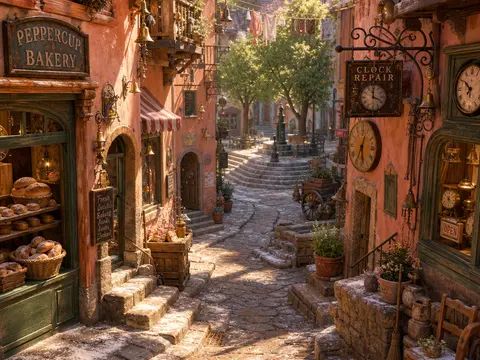
Peppercup Passage
Peppercup Passage is a narrow lane tucked between a bakery and a clock repair shop, where the walls are painted the color of faded peaches and the pavement is always lightly dusted with flour. Tiny brass bells hang from every doorway, chiming softly when the wind slips through, and the whole place smells warm and peppery, with hints of lemon peel, wet stone, and butter cooling on window ledges. Narrow steps climb and dip without warning, so the lane feels a little like walking over a bumpy ribbon. Above the street, laundry lines cross in messy loops, and small balconies lean out with potted herbs, chipped teacups, and bird nests tucked into the beams. Delivery carts squeeze through at slow hours, their wheels clicking over the stones, while cats nap in sunny patches and mopheads drip from iron hooks after rain. At the far end, the lane opens into a tiny square with a drinking pump and three linden trees, where leaves flutter into doorways and chalk marks fade by afternoon. The place feels snug, lively, and slightly crooked, with many little corners for errands, pauses, and surprises.



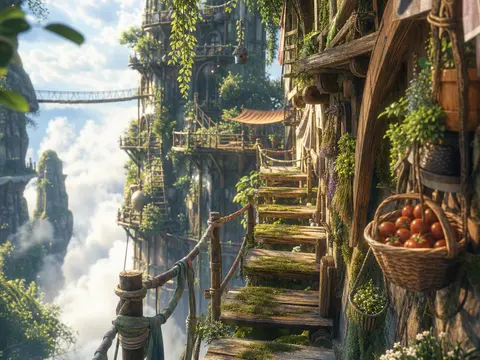
The Cloudstep Rungs
The Cloudstep Rungs are a chain of narrow, wooden platforms lashed to the side of a very tall sky-garden tower, where the air is cool, bright, and always moving. Soft moss pads the boards, vine leaves brush at shoulder height, and the rails are wrapped in faded cloth to keep little hands from slipping. Below, pale clouds drift so close they hide the ground for long stretches, and the whole place smells of wet bark, crushed herbs, and rain that has not yet fallen. The tower is climbed by a winding path of steps, ladders, and hanging bridges that sway gently when someone passes. Small birds nest in the beams, and baskets of plum tomatoes, leaf bundles, and drying flowers hang from hooks in tidy rows. Morning is for watering, midday for shade, and late afternoon for listening to the wind slide through the tower like a soft whistle. Sometimes a loose plank creaks, or a ribbon of cloud curls through an open gap, making the Rungs feel both snug and high above the world.




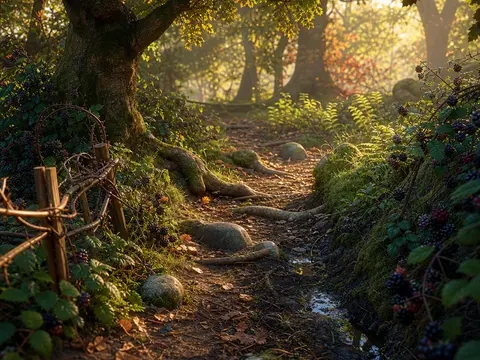
Acornbell Bramble Path
Acornbell Bramble Path winds through a warm patch of woodland where oaks, hazels, and wild blackberry tangles grow close enough to brush a sleeve. The air smells of leaf litter, sweet sap, and the tart green snap of crushed berries. Sunlight lands in broken gold on roots, fallen twigs, and rounded stones, while the shade beneath the brambles stays cool and blue. The path is never straight for long. It slips past a leaning fence of woven branches, climbs over two fat roots, then dips beside a rain-dark ditch where frogs sometimes tuck themselves into the mud. Small clearings open like pockets among the thorns, with old nut shells, feather scraps, and soft moss patches that show where animals and children have paused before moving on. On breezy days the blackberry canes click together, and after rain the leaves hold bright beads of water. The place feels busy with quiet life, a little scratchy, a little welcoming, and full of bends that can hide a turn, a nest, or a friend just ahead.




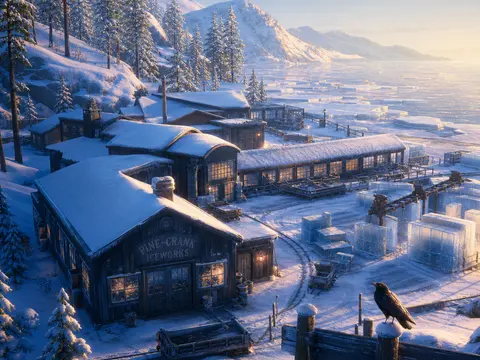
Pine-Crank Iceworks
Pine-Crank Iceworks sits in a sheltered bowl of snowfields at the edge of a frozen inland sea, where tall pines lean over stacked ice blocks and the whole place smells of frost, sap, and hot tea. The buildings are low and broad, with dark roofs weighted by snow and long sheds connected by covered walkways. Frost paints the windows from the inside out, and pale light slides across metal rails, wooden ramps, and the shallow grooves worn by boots and sled runners. Every morning, hand bells and creaking winches echo through the yard as workers move between the sheds, the drying racks, and the little stove rooms that glow amber in the blue cold. Puffins are absent here, but ravens hop along the fence posts, and white fox prints sometimes cross the back path before dawn. The wind can sweep loose snow into drifts against the doors, and the ice near the shore cracks softly at night, making the whole place feel awake. It is a place of narrow passages, slippery edges, warm corners, and many careful routes through the cold.




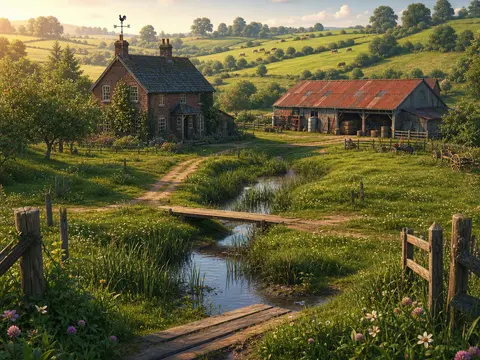
Cloverbell Fold
Cloverbell Fold lies in a wide bowl of green fields, where the grass grows in soft waves around a low brick farmhouse and a long shed with a rust-red roof. A shallow ditch filled with reeds bends through the middle, and two narrow plank paths cross it, always a little damp at the edges. The air smells of clover, warm dust, and fresh-cut apples from the little orchard tucked behind the barn. Days here follow the creak of a weather vane, the clink of milk pails, and the slow shuffle of cows in the shade. Chickens scratch under currant bushes, and a family of geese leaves bright footprints in the mud after rain. The place changes with weather: the path near the ditch turns slick, hay gets carried by the wind into corners, and tall grass hides small dips and ant trails. It feels busy but gentle, with open spaces, tucked-away corners, and many quiet places for noticing, helping, or wandering.




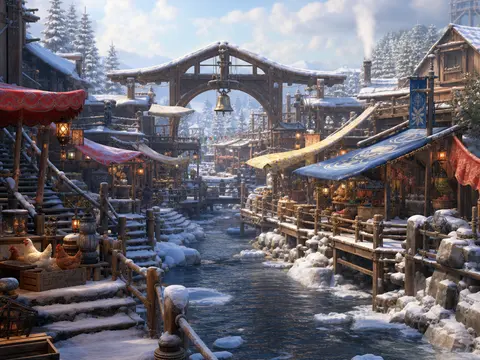
Larkspur Snowbridge Market
Larkspur Snowbridge Market stretches along a pale river that never fully freezes, where wooden walkways, rope handrails, and snow-packed courtyards step down between steep banks. The air smells of birch smoke, salt dough, and wet wool. Bright cloth awnings flap over narrow stalls, and the river below murmurs under skins of ice, dark and quick between white edges. Snow piles along stair rails and the roofs of storage sheds, while sled runners scratch paths through the market lanes. At the center is a long bridge with a weathered bell hung beneath its arch, and everything seems to gather and pause when it rings. Hens fuss in fenced corners, kettles steam outside doorways, and lanterns sway in the blue afternoon light. Some days the wind pushes snow through every crack; some days thawwater drips from eaves and turns the steps slick. It is a place of deliveries, waiting, and small errands, with many corners to duck into, many crossings to make, and many ordinary things to notice before they are buried or washed clean.





Moonjar Courtyard
Moonjar Courtyard sits inside a ring of whitewashed walls, tucked beneath a bluff of warm stone where the desert wind can only reach it in whispery threads. The ground is packed smooth and pale, with shallow channels that carry a little rain toward a cracked cistern in the center. Clay pots, chipped and round-bellied, stand along the walls like quiet guardians, and their cool shadows gather before sunrise. The courtyard smells of sun-baked dust, fig skin, and damp earth after watering. Narrow doorways lead to sleeping rooms, a bake nook, and a stair that climbs to the roof, where laundry flutters and the sky feels very close. Lizard tracks silver across the bricks by morning, and sand taps softly at the gate by evening. Life here moves with the heat: doors creak open early, then close against the afternoon hush, leaving the place still, bright, and full of small sounds waiting to be noticed.





Tarnedrift Steps
Tarnedrift Steps is a chain of wide stone stairways and little landing-gardens hanging above a bright sea of clouds. The steps are worn smooth by tiny feet and wheeled carts, and their edges are lined with wind-bent moss, drooping bells, and pots of rosemary that smell sharp when the breeze passes through. Sunlight comes and goes in patches, and the whole place shimmers between white glare and soft gray shadow. The stairways twist around half-finished terraces, laundry lines, pigeon roosts, and balconies painted in fading blue and lemon. Some landings are crowded and lively, while others feel quiet as a held breath, with only the creak of ropes and the rustle of cloud below. Morning winds can carry hats, napkins, or humming songs from one level to the next, and afternoon mist sometimes hides the far stairs until they reappear like a surprise. People and birds share the steps, leaving crumbs, chalk marks, and the occasional lost mitten behind.




Lantern Docks of Comet Harbor
Built into the bright crack at the tail of a sleepy comet, the Lantern Docks are a line of warm metal walkways, round hatches, and tiny lookout portholes set against a glittering wall of ice. Frost flowers bloom overnight on the rails, and every surface tastes faintly of mint and old pennies. Above and below, the harbor curves in a narrow ribbon, so footsteps echo in soft, floating taps and small objects sometimes drift until someone catches them. Comets and little traveling ships come and go in the long dawn, leaving behind ribbons of steam, boot prints, and the smell of citrus fuel. The dock lamps glow peach and gold through the cold, making pockets of comfort beside the windy gaps. Sparse moss grows in sheltered corners where water beads and lingers, and the nearest tunnel is always damp with meltwater. Bells ring when the ice shifts, and the whole harbor gives a tiny shiver, as if waking up.




Kelpbone Steps
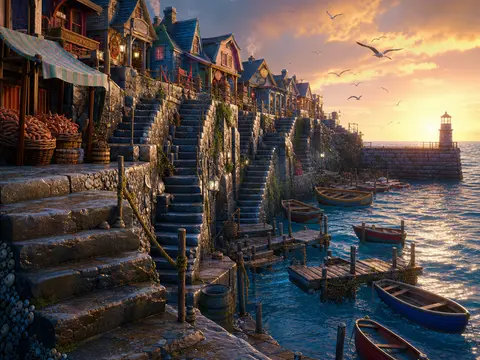
Kelpbone Steps is a steep harbor built into a crescent of black stone, where narrow stairways drop from the cliff road to the water in uneven little flights. The steps are damp even on bright days, scented with salt, wet rope, and the sweet smoke from oven vents tucked behind the shops above. Between the stairs, old sea walls hold shells, barnacles, and pale streaks where waves have licked the rock clean. At morning, baskets of shrimp, stacked coils of line, and striped market cloths appear along the upper landings, while below, skiffs nudge against floating docks that rise and sink with the swell. The wind moves in surprising bursts here, rattling signs and tugging at loose hoods before slipping quiet again around the breakwater. Children and dockhands know the harbor by its landings, rails, and little turnings, where a person can pause out of the spray. Some steps are worn smooth and shiny, and one corner always gathers puddles that mirror gulls wheeling overhead, making the place feel lively, watchful, and just a little bit slippery.





Buttonwharf Hollow
Buttonwharf Hollow sits in the scoop of a wide river bend, where bright wooden wharves step down in crooked layers and old boat ropes lie coiled like sleeping snakes. The air smells of wet boards, pear peel, river silt, and the sweet dust from the button-maker’s shop on the hill. Tiny drawers, spool racks, and hanging trays give the lanes a busy, tinkling look, while gulls and river sparrows hop between awnings patched in faded stripes. At low tide, little mud mirrors appear between the planks, and at high water the lower steps vanish with a soft sucking sound. Children cross on narrow bridges, past nets drying on poles and a row of lanterns painted with stars that never quite match. Bits of life turn up everywhere — a lost mitten button, a fish scale caught in a crack, a toy boat wedged under a bench. The whole place feels gently lopsided, always in motion, and full of small corners where something forgotten might be waiting to be found.





Lantern Quay
Lantern Quay is a narrow harbor of leaning wooden piers, salt-dark ropes, and little sheds with painted doors that peel in curls. At low tide, the mudflats shine like dull silver, and tiny pools hold sky reflections and crab tracks. The air smells of seaweed, warm tar, and bread cooling on windowsills. Each evening, as fog begins to slide in from the bay, the quay lights its round glass lanterns one by one. Fishermen mend nets on upturned crates, children hop between painted mooring posts, and gulls pace the roofs as if counting. The tide changes the shape of everything: steps appear, then vanish; mud paths open, then sink; and the lower piers must be crossed before the water returns. Behind the piers, narrow lanes hold laundry lines, a small fish-smoke shed, and a tea room with a bell that rings softly when the door opens. The place feels busy but never hurried, shaped by tide, fog, lantern light, and the careful timing needed to move safely between harbor, lane, and shore.





Driftwhistle Harbor
Driftwhistle Harbor sits where a low line of cliffside cottages meets a frozen bay, and the whole place seems to listen to the wind. Snow gathers on rope rails, window ledges, and the tops of stacked crab pots, while the sea keeps breathing under blue-white ice, making soft booming sounds that carry through the cove. The lanes are narrow and glitter with packed snow, curving between tilted sheds, a little schoolhouse, and the lantern room on the point. Smoke smells of cedar and fish stew, and mittened neighbors leave sled tracks between doorways. Each morning, gulls circle above the harbor, and each evening the lanterns turn the snow gold. Sometimes the fog comes in low, hiding the boats until their masts appear like pencils, and sometimes seals nap on the ice near the breakwater. Wind can bury familiar tracks in minutes, ice can make the shortest path too slick, and the lantern room becomes the safest landmark when snow begins to blur the lanes.




Pumpkinbridge Meadow
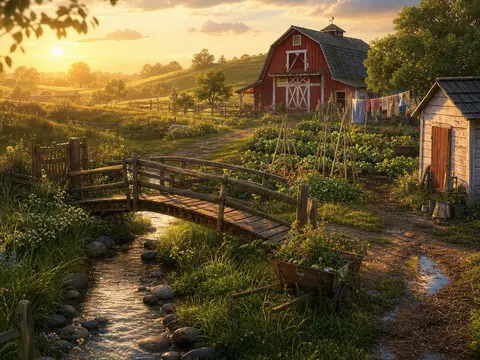
Pumpkinbridge Meadow spreads wide and soft beneath a low hill, where long grass brushes ankle-high fences and the air smells of hay, earth, and warmed milk. A crooked wooden bridge crosses a narrow brook that chatters over smooth stones, and beyond it sit a red barn, a white shed, and a patchwork of vegetable rows with bean poles leaning like sleepy dancers. Morning begins with roosters, creaking gates, and the slow clop of boots in the yard. By afternoon, bees hum over clover while laundry flutters on a line, and at dusk the meadow turns silver-green with moths near the porch light. Barn cats drift along the edges, and the farm day keeps changing shape around chores: gates must be latched before goats wander, rows turn muddy after rain, and the crooked bridge grows slippery when the brook runs high. Small puddles, muddy tracks, and wind-tossed straw make every corner feel ready for a small adventure.




Juniper Gate Thicket
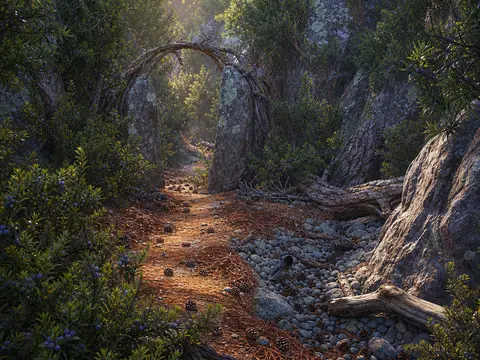
Juniper Gate Thicket lies where the forest tightens into a narrow green corridor between two rocky banks. Juniper shrubs crowd the path with a sharp, clean scent, and their needle leaves prick the air with silver when the light slips through. The ground is striped with pine cones, soft red needles, and patches of sandy soil where little paws have scuffed bright trails. Halfway through the thicket stands a split stone marked by rain and lichen, with a low arch of tangled roots leaning over it like an old doorway. Nearby, a dry creek bed curves under fallen branches, easy to cross in quiet weather but quick to channel rainwater after a storm. Everything feels a little secret and a little watchful. Wind makes the juniper berries rattle faintly, the root arch narrows the path to single file, and the bends of the thicket can hide a friend who is only a few steps ahead.




Brineglass Quay
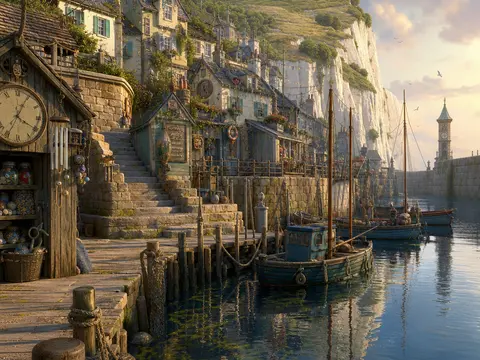
Brineglass Quay sits where a narrow blue harbor curls beneath steep chalk hills, and the air always tastes faintly of salt and pear skins from the market carts along the quay. The water is very still inside the breakwater, dark as polished glass, with pale green ribbons of weed drifting below the surface and long reflections of shutters, masts, and washing lines trembling in the ripples. Along the stone steps and timber wharves are weathered net-menders' sheds, a clock with a cracked face, and little tide-worn alcoves where the wind grows quieter before turning back toward the water. The chalk hills behind make a pale backdrop so bright at midday that everything against them looks darker and more particular. A low wall runs the length of the quay's outer edge, worn smooth on top by years of elbows and weather, with iron cleats rusted to the color of autumn leaves. The tide comes in at dusk and retreats before dawn, covering the lower steps, narrowing the wharf paths, and leaving only a short window when the alcoves can be reached safely.



Moonbean Market
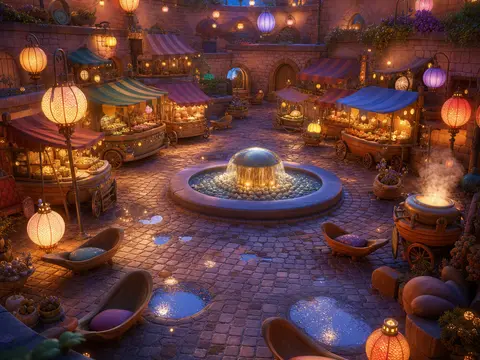
Moonbean Market fills a round stone courtyard in the last hour before midnight, when the cobblestones have held the day's warmth and give it back slowly through the soles of shoes. Painted lanterns — some shaped like fish, one like a crescent — hang on wires strung between the buildings, and their light laps at everything in a gentle orange-pink. Between the awning poles, puddles from the evening rain mirror the lantern shapes so there are two markets, one above and one below, slightly wobbling. Steam carts run between the stalls trailing apricot-scented clouds, and curved benches are set so that visitors watch each other as much as the goods. The slow stone fountain at the center is always running — water crossing smooth pebbles into a shallow basin where coins have settled in overlapping layers. The surrounding buildings are tall and close, with laundry lines running between their upper windows, and the courtyard holds sound in a specific way that makes everything said there seem slightly more important than it would be elsewhere.





Saffron Dune Market
Saffron Dune Market runs along the base of a sandstone wall at the edge of the desert, where the dunes begin to flatten and the first clay-brick buildings lean against each other for shade. Striped canvas awnings — yellow, rust, cream — flap at the corners where they are pegged too loosely, and fine sand gathers in the seams and folds. The air smells of dust, bruised mint, cumin, and the sweetness of melon sliced open in the heat. Stalls are arranged without a plan, so brass cup sellers give way to rope coilers give way to a shaded nook where cloth hangs drying in long indigo sheets that bleed at the edges. In the middle of the market a clay water jar stands under a canopy, its sides sweating in the afternoon. The sand underfoot is crossed with tracks — sandal marks, hoof prints, bird feet — and the shadows move slowly westward as the day tips. At the far end, a low archway opens onto the open dune, where the wind has shaped the sand into a long smooth ridge that is different every morning.




Mossy Lantern Harbor
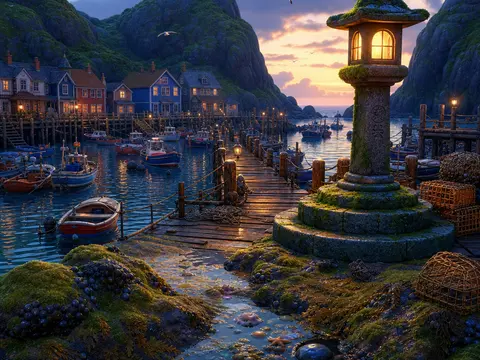
Mossy Lantern Harbor tucks behind a curve of dark, water-worn cliffs that hold the wind off, so the air inside the harbor is calmer than the sea beyond. The boats bob in short, regular arcs — mooring ropes creaking — and the stone lantern at the end of the main pier has stood long enough that moss has grown up its base in a green collar. Its warm glass face casts a runway of orange light across wet planks at night, reaching the crab pots, coiled rope, and stacked net-floats near the harbormaster's shed. At low tide the harbor empties by half, and a wide apron of mussel-covered rock appears between the pier legs, scattered with tide pools holding small orange crabs, closed anemones, and the occasional smooth coin of sea glass. The chalk line of the high-water mark circles everything — piers, rocks, the rusted ladder rungs — like a quiet record of where the sea has been. Herring gulls call from the cliff ledges above and drop mussel shells to crack them on the stone below.





Seaglass Coral Cove
Seaglass Coral Cove opens from a narrow tunnel of dark rock into a wide green-blue underwater chamber where filtered light falls in long columns and makes everything below waver like a slow breath. Swaying ribbons of kelp divide the space into rooms without walls, and broken coral arches rise from the sand floor — some smooth and pink, some branching and rough, some crusted with tiny barnacles that look like sleeping eyes. Tiny silver fish move in tight formations through the tunnels, banking left or right all at once as if they share one thought. Larger shells sit half-buried in the sand, their openings facing different directions. Wide flat stone ledges protrude from the walls at different heights, their surfaces worn and gently sloped, holding pools of trapped water in their low spots. Currents can shift the kelp curtains quickly, opening one path while closing another, and smaller swimmers feel the pull of the tunnels sooner than larger ones do.




The Pebble Ring Observatory
The Pebble Ring Observatory stands on a moon that spins slowly enough to feel like stillness — a squat stone building with cracked steps and a copper dome gone the color of old sky. Around it, silver pebbles skitter across the flat ground as the moon turns, rolling in gentle arcs that chime softly when they meet, a sound like distant wind chimes heard from inside a house. The air is thin and cold and smells faintly of rain on warm metal. Inside, a single brass telescope takes up most of the floor, angled through a dome slit toward a cluster of bright planets close enough to seem personal. The walls are scratched with old measurements and small drawings — a bird shape, a repeating spiral, a name in a language that might be numbers. Starlight catches the dust that floats in slow spirals whenever the door opens. At night the largest planet fills the lower sky, striped orange and cream, humming at a frequency felt rather than heard.




Mossy Lantern Hollow
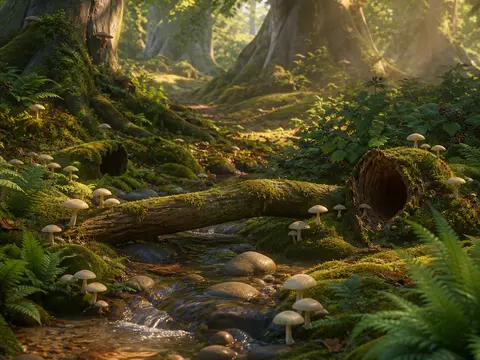
Mossy Lantern Hollow sits where two beech trees have grown so close together their roots braid underground, making the ground between them soft and pillowed. A clear stream comes in from the north side, slipping over water-worn stones in long, unhurried steps, and exits under a fallen log that doubles as a low, wobbling bridge. On either side of the log grow bramble runners and broad ferns that press against each other in damp overlap. Pale mushrooms grow in quiet clusters along the hollow's inner walls — some as small as thumbnail coins, one or two as wide as a cupped hand. The hollow stump near the eastern edge smells of rain and old wood, and the damp ground around it holds footprints longer than the drier paths above. Branches overhead filter the light into coins and slow slants, but after rain the stream rises around the log bridge, the ferns lean across the path, and the hollow becomes a place where small travelers must choose their steps carefully.





Mosslight Fen
Mosslight Fen spreads out in low, wet layers — spongy cushions of green moss, black reed water, and the slow drip of everything into everything else. Pale mushrooms cluster under the cattail stalks, their caps giving off a faint blue-green glow when the light fades, as if they borrowed the moon and forgot to return it. The air carries rain on mud, crushed mint, and something darker underneath — the smell of places that have been wet for a very long time. Pools of still water hold the reflections of reeds like careful drawings, and moon-pale dragonflies hover and vanish. The ground gives a little underfoot, then more than a little. Fallen branches are furred with moss to the tips, and a wooden post leans at the edge of the deepest channel, rope ring rusted orange from old use. Sound travels strangely through the reeds, paths that look firm may sink at the edges, and dusk makes the glowing mushrooms useful markers for anyone trying to find the safe way back.